The setup
- Home
- Large two-story house with a complex roof and several bath fans
- Finding
- Dark staining across north-facing attic sheathing
- Concern
- Buyer unsure whether the problem is active or old
- Note
- Hypothetical; not a real property or transaction
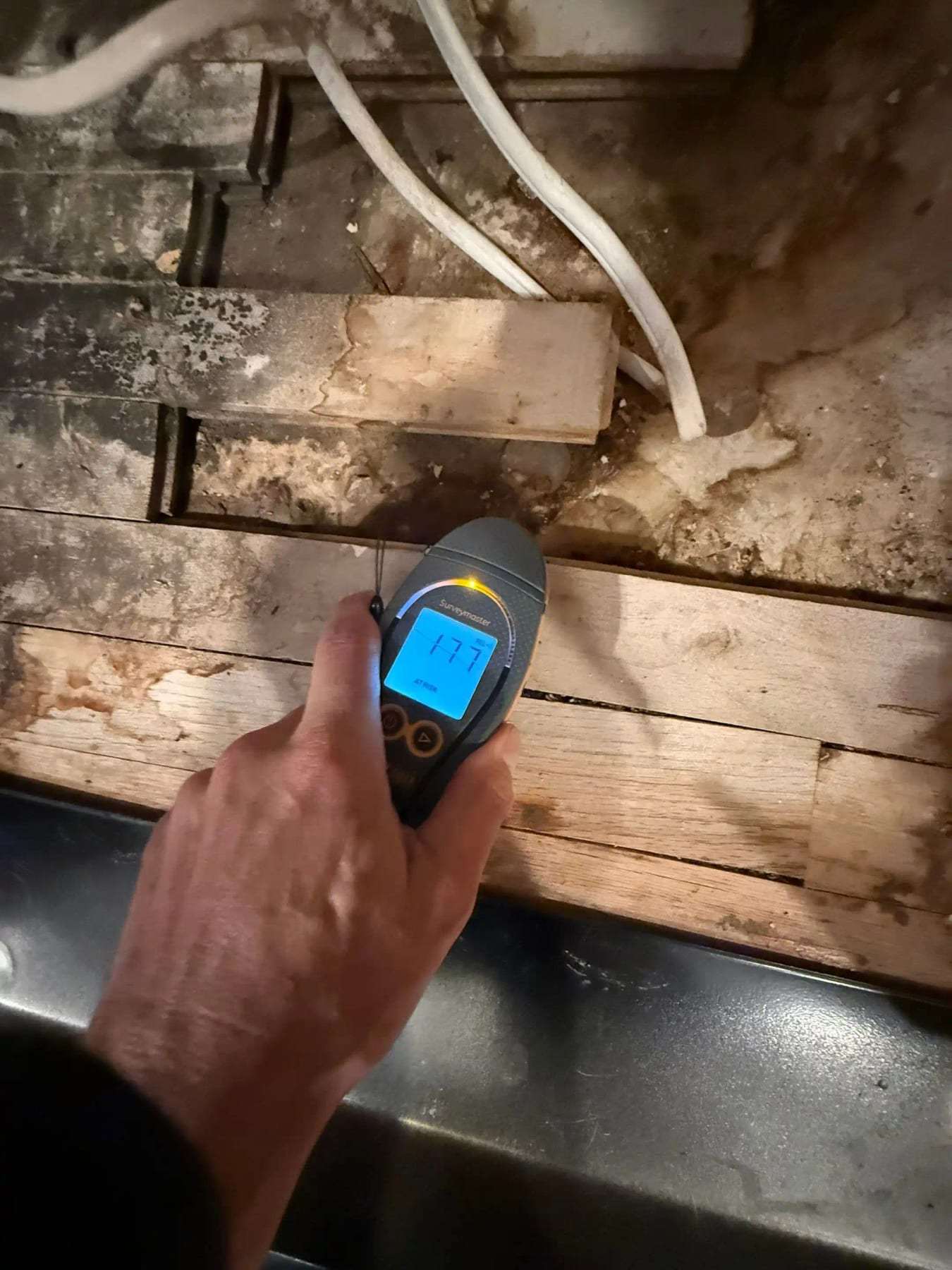
Moisture meter held against a subfloor with dark staining along the boards. Example of the work involved; the photo does not show a specific property or a job for this site.
What the parties did
Illustrative example. Not a real job or customer.
Partway through the inspection period, the buyer's home inspector photographs staining on the attic sheathing and recommends evaluation. The seller had not been in the attic in years.
- The agents agree to an independent assessment, with the cost and choice of assessor settled in writing.
- The assessor finds the staining concentrated near two bath fans whose ducts had come loose and were blowing into the attic.
- Moisture readings show the sheathing is currently dry, suggesting the growth is not spreading in the summer months but would recur in winter.
- The seller has the fan ducts reconnected and routed outdoors and hires a remediation contractor to clean the affected sheathing under containment.
- The assessor performs a follow-up visual and moisture check and issues a short report.
- The seller provides the buyer with photos, the remediation scope, the duct repair invoice and the assessor's report.
The buyer accepts the documentation and the transaction closes on its original schedule, with the records kept for the new owner's files.
Choices that shaped the outcome
- IfThe buyer could have asked for a large credit without knowing the scopeThenAn independent assessment defined the problem first, which made negotiation simpler.
- IfThe seller could have hired a contractor to test and removeThenKeeping the assessor independent made the results more credible to the buyer.
- IfThe cleanup could have skipped the fan ductsThenFixing the moisture source was part of the agreement, so the buyer had reason to trust it would not return.
Questions either side might ask in a similar situation
- Is the growth active, and what is the moisture source?
- Who chooses and pays for the assessor?
- What documentation will show the work is complete?
- Does the timing fit within the contract deadlines?
Common questions
- Does attic staining always mean active mold?
- No. Staining can be left from a problem that was fixed long ago, or it can be growth that wakes up every winter. Moisture readings, the pattern of the staining and a look at bath fans and air leaks help tell an old stain from a recurring one.
- Should a buyer walk away over an attic mold finding?
- That is a personal and financial decision to make with an agent. Many attic findings have a clear, fixable cause, such as disconnected fan ducts, and a documented repair is often enough to move forward. Larger or unexplained problems deserve more caution and a fuller assessment.
General information for Cherry Hills Village, not a quote or professional advice. In an emergency, call 911.